
We’re happy to announce that Slog now supports MCP (Model Context Protocol). This means Slog’s time-tracking features can now be accessed by AI agents — securely, and without being limited to Slog’s own interface.
What is MCP?
The Model Context Protocol (MCP) allows AI agents to interact with external tools, data, and workflows in a structured and secure way. Instead of copying data back and forth or building custom integrations for every interface, MCP provides a standard way for AI agents to:
- read data
- write data
- trigger actions
- query systems
With MCP, Slog exposes its time-tracking capabilities to AI agents such as ChatGPT, Copilot, Gemini, or any MCP-compatible environment without locking users into a specific UI or workflow.
Slog becomes usable wherever AI agents can operate, not only inside the Slog app.
Time tracking with MCP
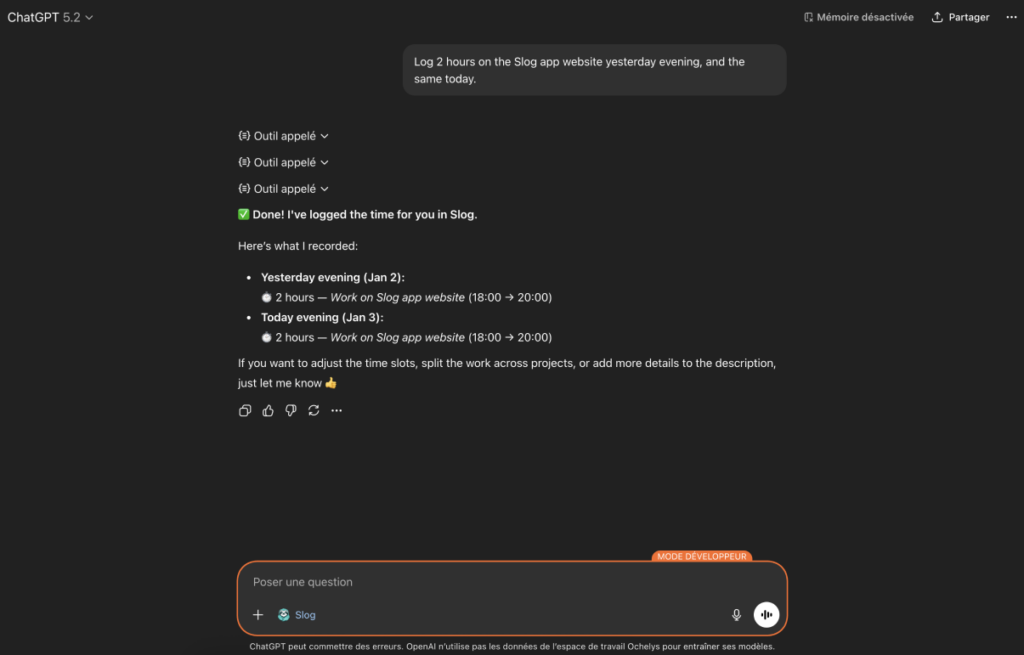
Here are some concrete examples of what MCP enables with Slog:
- Describe a work week in natural language and log it as time entries
- Ask how much time was spent on a project, client, or task
- Compare estimated vs actual time without exporting data
- Generate a client-ready report on demand
- Retrieve summaries or breakdowns without building spreadsheets
All of this uses the same Slog data and rules. MCP just makes access more flexible.
Want to try MCP time-tracking?
MCP support opens the door to new usage patterns, and we’ll keep refining how Slog fits into them. If you’re curious to try it, or want to explore what MCP-enabled time tracking looks like in practice, you can start with Slog today.